
If you are caring for an aging parent or loved one, you have probably heard home care and home health care. Although they sound similar, they provide very different types of support. Choosing the wrong one could mean paying for services you don’t need or delaying the care your loved one requires.
The difference among home care and home health care is simple because home care provides non-medical assistance for daily normal activities like bathing, meal preparation, and companionship, while home health care provides skilled medical services prescribed by a doctor, such as care from nurse, physical therapy, and wound care.
In this guide, you will know the differences between home care and home health care, typical costs in Texas, what Medicare and Medicaid may cover, and how to choose the right option for your loved one’s needs.
What Is Home Care?
Home care is known as non-medical home care, personal care, or companion care that provides non-medical assistance to help older adults live independently and safely in their own homes comfortably. Unlike home health care, home care does not require a doctor’s referral and is delivered by trained caregivers rather than licensed medical professionals.
Home care services typically include:
- Personal care assistance: Assisting with bathing, dressing, personal grooming, toileting, and mobility.
- Companionship: Social activity that involves talking and interaction to alleviate feelings of loneliness and isolation.
- Meal preparation: Planning and preparing nutritious meals while accommodating dietary needs.
- Light housekeeping: Laundry, dishwashing, tidying, and other household tasks.
- Transportation: Assistance with medical appointments, grocery shopping, errands, and social outings.
- Medication reminders: Encourage senior to take medications on time (without administering them).
- Dementia and Alzheimer’s care: Safety supervision, routine support, and specialized caregiving techniques for individuals living with memory loss.
The most significant benefit of home care services is their flexibility. These services can start at any time when the family requires more assistance. This can be because of a fall, because the daily chores are becoming difficult, or because the family caregiver requires some rest.
For many Texas families, home care is just the primary step in helping an aging loved one remain safe, independent, and comfortable at home long before skilled medical care becomes necessary.
What Is Home Health Care?
Home health care involves skilled medical treatment provided at the patient’s place by healthcare professionals who are licensed to practice their profession. Unlike home care, home health care involves a referral from a doctor and is normally recommended to those patients who have recovered from an illness, injury, or are recuperating after surgery or some kind of disease.
Home health care services typically include:
- Skilled nursing care: Wound care, injections, catheter care, medication management, and monitoring vital signs.
- IV therapy: Administration of intravenous medications and fluids at home.
- Physical therapy: Improving strength, balance, and mobility after surgery, a fall, or a stroke.
- Occupational therapy: Helping patients regain the skills needed for everyday activities after an injury or illness.
- Speech therapy: Supporting communication, speech, and swallowing difficulties caused by conditions such as stroke or neurological disorders.
- Post-hospital recovery care: Short-term medical care designed to promote recovery and reduce the risk of hospital readmission.
Unlike home care, home health care is temporary and for certain goal. Care is provided until the patient achieves a specific medical outcome, such as wound healing, regaining mobility, or safely recovering after hospitalization.
In many instances, Medicare will pay for home health services if a physician confirms that the individual is homebound and needs intermittent skilled care. Eligibility, coverage, and payments under Medicare will be discussed further in this guide.
Home Care vs. Home Health Care: What is the Main Difference?
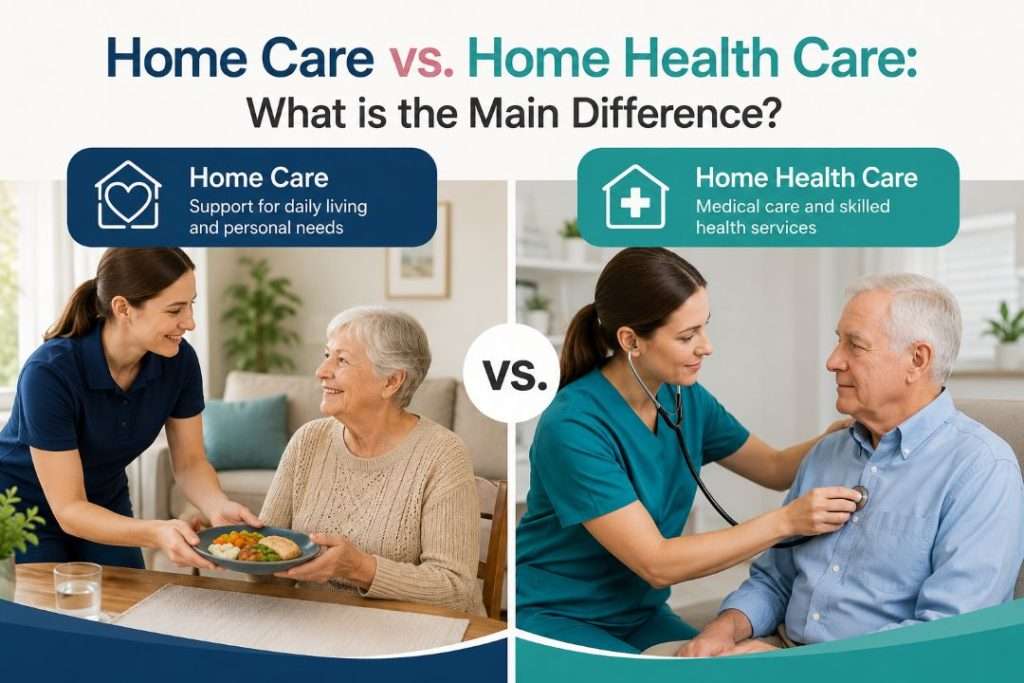
Home care provides non-medical support with everyday activities such as bathing, dressing, meal preparation, companionship, and transportation. It is typically paid for privately and can be arranged on a flexible, long-term basis. Whereas home health care provides skilled medical services, including nursing care, wound care, physical therapy, and other treatments prescribed by a doctor. It is often covered by Medicare or insurance when eligibility requirements are met and is usually provided for a short period during recovery or rehabilitation.
For a quick comparison, the table below shows the differences between home care and home health care, making it easier to determine which option best fits your loved one’s needs.
| Factor | Home Care | Home Health Care |
|---|---|---|
| Purpose | Support daily living and independence | Treat a medical condition or aid recovery |
| Services | ADLs, companionship, meals, housekeeping, transportation | Skilled nursing, therapy, wound care, medication management |
| Caregiver qualifications | Trained caregivers, not medically licensed | RNs, LPNs, licensed therapists |
| Medical treatment | No | Yes |
| Insurance coverage | Rarely covered; mostly private pay | Often covered by Medicare/Medicaid/insurance |
| Typical cost | Hourly, based on private-pay rates | Often billed to insurance; out-of-pocket varies |
How to Know Which Type of Care Your Loved One Needs
Choosing the right type of care doesn’t have to be complicated. The table below can help you quickly determine which service is most appropriate based on your loved one’s needs.
| If your loved one | They likely need |
|---|---|
| Recently had surgery or was discharged from the hospital | Home Health Care |
| Needs help with bathing, dressing, meal preparation, or companionship | Home Care |
| Requires skilled nursing, wound care, injections, or physical therapy | Home Health Care |
| Has dementia or memory loss and needs supervision and daily support | Home Care |
| Needs ongoing assistance with everyday activities | Home Care |
| Requires both medical treatment and help with daily living | Home Care + Home Health Care |
While this table provides a quick answer, every family’s situation is different. Here are the three most common scenarios to help you decide with confidence.
Scenario 1: Recovery After Surgery or Hospitalization
Home health care is normally the appropriate option if you have a family member who is either recently out of the hospital or recovering from a surgery, a stroke, or an illness. Your physician can write orders for your family member’s nursing, therapy, and wound care to help him/her recover and prevent hospitalization.
Scenario 2: Support With Everyday Living
If your loved one has good health, but he/she has difficulty performing normal daily activities such as bathing, dressing, meal preparation, housework, and going out for appointments, then home care is the best solution for him/her. Home care revolves around helping elderly individuals to stay safe and comfortable at home.
Scenario 3: Medical Care and Daily Assistance
Many seniors require both kinds of services concurrently. For instance, a patient undergoing surgery would benefit from having home health nurses come to his house to visit him while he is simultaneously requiring a caregiver to assist with such tasks as bathing, meal preparation, movement, and companionship.
Not sure about what kind of care you should be getting for your loved one? Having a care assessment by an expert can assist you in finding out what type of care will suit them best based on their health and mobility requirements.
If you’re still unsure whether your loved one is ready for professional support, recognizing the early warning signs can help you make the right decision. Read our guide, 10 Signs Your Aging Parent May Need In-Home Care, to learn what to watch for before choosing a care option.
Still Unsure Which Type of Care Is Right for Your Loved One?
Every family’s situation is different. Our care specialists can help you understand your options, answer your questions, and recommend the right level of support based on your loved one’s health, lifestyle, and daily care needs with no pressure and no obligation.
Can You Receive Home Care and Home Health Care at the Same Time?

One of the most common questions families ask is, “Can my loved one receive both home care and home health care at the same time?” The simple answer is yes.
In fact, it is quite common for seniors to need both types of services at once. While home health care takes care of the treatment aspects of a senior’s healthcare as prescribed by their physician, home care is the type of care that takes care of their safety and comfort needs in order for them to stay independent at home.
Here’s what a combined care schedule might look like:
| Time of Day | Care Provided |
|---|---|
| Morning | A registered nurse or physical therapist visits to monitor recovery, provide wound care, administer treatment, or complete a therapy session. |
| Afternoon | A home caregiver assists with bathing, meal preparation, light housekeeping, mobility, and companionship. |
| Evening | Family members or caregivers help with dinner, medication reminders, and ensuring the individual is comfortable and safe for the night. |
This combination is especially common for older adults recovering from surgery, stroke, or hospitalization, as well as those living with chronic conditions such as Parkinson’s disease or dementia.
While home health care focuses on skilled medical treatment and rehabilitation, home care provides ongoing assistance with daily activities, helping individuals remain safe and independent between medical visits. For families caring for someone with Parkinson’s disease, understanding how care needs change over time can make planning easier. Read our guide on The 5 Stages of Parkinson’s Disease and What In-Home Care Looks Like at Each Stage to learn what support is needed as the condition progresses.
With the help of both services combined, a family will be able to make sure that their relative has all the necessary assistance to recover safely and live an independent and comfortable life at home.
Cost of Home Care vs. Home Health Care in Texas
Cost is one of the primary issues for families. Although rates differ depending on what you need, your area, and who provides services, knowing about the way in which home care and home health care are usually paid for in Texas can be useful.
Home Care Costs (Private Pay)
Home care is generally paid for privately and is billed based on the amount of support your loved one needs. Most agencies offer flexible scheduling, allowing families to choose care that fits both their needs and budget.
Typical billing options include followings:
- Hourly care: Best suited for the elderly who need help for several hours each day. Most agencies have a minimum time limit for the visit which is either 3 or 4 hours.
- Daily care: Suitable for people who require help for an entire day that could be from 8 to 12 hours.
- Weekly or monthly care: Designed for families who required ongoing, long-term assistance on a consistent schedule.
- 24-hour care: Offered through the help of shifts in caregivers for the senior citizens who need constant attention.
Home Health Care Costs
Unlike home care, home health care is often covered by Medicare, Medicaid, or private insurance when it is medically necessary and prescribed by a physician.
If insurance is covered for you, then the expenses would be minimal to none at all for the patient. Insurance depends upon what plan you have and the provider being in network. When home health care is not covered by insurance, services are typically billed per visit rather than by the hour, with costs varying based on the type of skilled medical care provided.
How Can You Pay for Home Care in Texas?

Families in Texas may be able to pay for home care or home health care through one or more of the following options:
- Medicare (primarily for eligible home health care services)
- Texas Medicaid, including programs such as STAR+PLUS
- Long-term care insurance
- Veterans benefits, including the Aid & Attendance program for eligible veterans
Private pay for services not covered by insurance, because non-medical home care is usually not covered by Medicare, many families pay for these services out of pocket. Understanding the payment options and assistance programs available in Texas can help you choose the right care while managing costs more effectively.
Does Medicare Cover Home Care?
One of the most common questions families ask is, “Does Medicare cover home care?” The short answer is that it depends on the type of care your loved one needs. Generally, Medicare covers medically necessary home health care but does not cover non-medical home care services.
| Service | Medicare Coverage |
|---|---|
| Skilled nursing care | Covered (when medically necessary and prescribed by a doctor) |
| Physical, occupational, and speech therapy | Covered |
| Companion care | Not covered |
| Meal preparation | Not covered |
| Housekeeping | Not covered |
| Personal care (bathing, dressing, grooming) | Generally not covered |
Some Medicare Advantage plans may offer limited non-medical home care benefits, but coverage varies by plan. If your loved one mainly needs help with daily activities rather than medical treatment, Texas Medicaid programs and other financial assistance options may provide better coverage.
Texas Programs That May Help Pay for Care
Texas families have more options than the national averages suggest, but most of these programs are underused simply because families don’t know they exist.
- STAR+PLUS: A Texas Medicaid managed care program that combines acute care and long-term services, including personal attendant care, for eligible adults aged 65+ or with disabilities. This is one of the primary ways non-medical home care gets funded for lower-income Texas seniors.
- Community First Choice (CFC): Texas Medicaid program that provides personal care and habilitation services to those who have eligibility through functional need, which allows many senior citizens to get home care without spending down their entire private resources.
- Medicaid (general): Beyond STAR+PLUS and CFC, traditional Medicaid can cover home health services for qualifying low-income Texans.
- Veterans Benefits (Aid & Attendance): For veterans and surviving spouses who qualify, the VA’s Aid & Attendance benefit can help offset the cost of in-home caregiving, in addition to a standard VA pension.
- Long-term care insurance: If your loved one purchased a policy years ago, now is the time to pull it out and check exactly what it covers. Many policies cover non-medical home care that Medicare won’t touch.
Because so few home care providers explain these programs clearly, this is often the single biggest opportunity for Texas families to reduce out-of-pocket costs; it’s worth a conversation with a Texas HHSC (Health and Human Services Commission) caseworker or an elder law attorney to confirm eligibility.
What Are the Benefits You Can Get from Home Care and Home Health Care?
Both home care and home health care help older adults remain safely at home, but they do so in different ways. Home care focuses on improving daily quality of life and independence, while home health care provides skilled medical support to promote recovery and manage health conditions.
| Benefits of Home Care | Benefits of Home Health Care |
|---|---|
| Helps seniors maintain independence in the comfort of their own home | Provides skilled nursing and medical care without requiring a hospital or facility stay |
| Supports daily activities such as bathing, dressing, meal preparation, and mobility | Promotes faster and safer recovery after surgery, illness, or injury |
| Reduces loneliness through companionship and emotional support | Helps reduce hospital readmissions with ongoing medical monitoring |
| Gives family caregivers time to rest while remaining actively involved in their loved one’s care | Offers professional physical, occupational, and speech therapy at home |
| Care plans can be personalized and adjusted as needs change | Ensures medications and treatments are managed by licensed healthcare professionals |
| Flexible scheduling from a few hours a week to 24-hour care | Provides short-term, goal-oriented care focused on recovery and rehabilitation |
At last, the right choice depends on your loved one’s needs. If they require assistance with everyday activities, home care is often the best option. If they need skilled medical treatment prescribed by a doctor, home health care is the appropriate choice. In many cases, combining both services provides the most comprehensive support.
Why Many Texas Families Choose Home Care First
Home care comes before anything else for many individuals and families in North Tarrant County such as Bedford, Hurst, Euless, Colleyville, and Grapevine because it’s one of the first actions that people will take when it comes to caring for their parents. The parent who may not need a nurse at all but could really use the care to help with aging in place.
Choosing home care early also help to build a good relationship with a caregiver who is familiar with the household, routines, and preferences, so if a medical need does arise later (a fall, a surgery, a new diagnosis), the family isn’t starting from scratch. They already have a trusted team in place, ready to coordinate with a home health provider if and when that becomes necessary.
Which Type of Care Is Right for Your Loved One?
Choosing among home care and home health care becomes much easier once you understand the purpose of each service. Home care provides non-medical support with everyday activities, helping older adults remain safe, independent, and comfortable at home. Home health care, on the other hand, delivers skilled medical services prescribed by a doctor to support recovery, rehabilitation, or the management of a medical condition.
For many families, the best solution isn’t choosing one over the other it’s combining both services to ensure their loved one receives complete medical and daily living support.
If you’re caring for a loved one in North Tarrant County, Texas, and aren’t sure which type of care is right, the CareBloom team is here to help. We’ll take the time to understand your family’s needs, explain your options, and help you create a proper personalized care plan that gives your loved one the support they deserve while remaining safely at home.
Give Your Loved One the Care They Deserve Right at Home
Whether your family needs compassionate daily assistance, skilled medical care, or a combination of both, CareBloom is here to help. We’ll create a personalized care plan that fits your loved one’s unique needs so they can continue living safely, comfortably, and independently at home.
Frequently Asked Questions
1. Can a person receive home care and home health care at the same time?
Many older adults benefit from receiving both home care and home health care at the same time. Home health care focuses on skilled medical services such as nursing, wound care, and physical therapy, while home care provides assistance with everyday tasks like bathing, meal preparation, transportation, and companionship. Combining both services allows seniors to receive medical treatment while also getting the daily support they need to remain safe, comfortable, and independent at home.
2. Does Medicare pay for home care or only home health care?
Medicare primarily covers medically necessary home health care when it is prescribed by a doctor and the patient meets eligibility requirements. This may include skilled nursing, physical therapy, occupational therapy, or speech therapy provided at home. However, non-medical home care services such as companionship, housekeeping, meal preparation, and personal care are generally not covered under Original Medicare. Some Medicare Advantage plans may offer limited coverage for these services, depending on the specific plan.
3. How do I know when my parent needs home care instead of home health care?
The type of care your parent needs depends on their health and daily living abilities. Home care is often the right choice when they need assistance with bathing, dressing, meal preparation, transportation, housekeeping, or companionship but do not require medical treatment. Home health care is more appropriate when a doctor prescribes skilled nursing, wound care, physical therapy, or other medical services after an illness, injury, or surgery. In some cases, combining both services provides the most complete support.
4. Is home care cheaper than home health care?
The overall cost depends on the type of care required, how often services are provided, and whether insurance covers the care. Home care is usually billed by the hour and is commonly paid for out of pocket because it involves non-medical assistance. Home health care, on the other hand, is often covered by Medicare, Medicaid, or private insurance when it is medically necessary and prescribed by a physician. Comparing your loved one’s care needs and available coverage is the best way to estimate total costs.
5. What conditions qualify someone for home health care?
Home health care is commonly recommended for individuals recovering from surgery, hospitalization, illness, or injury who require skilled medical treatment at home. It may also be appropriate for people who need wound care, IV therapy, medication management, physical therapy, occupational therapy, or speech therapy. A physician must determine that home health care is medically necessary and create a care plan before services can begin.